You open the water bill, look at the number, and look again.
That can't be right. Nothing changed this month.
Deep breath. If you're in Atlanta, you're not imagining it, and you're not alone. Our city has some of the highest water and sewer costs in the country. A Black & Veatch survey of America's 50 largest cities found Atlanta's typical combined water and sewer bill is the third highest in the nation, just under $200 a month, behind only Seattle and San Francisco. So even a normal month can sting.
But a bill that suddenly jumps well past your normal? That's not "rates are high." That's a signal.
Let's walk through what counts as a normal fluctuation, what counts as a red flag, and what you can check yourself before calling in a leak detection specialist like PV Heating, Cooling & Plumbing.
Is a higher water bill ever just... normal?
Sometimes, yes. If your bill is up around 10%, that's usually just life. You had guests. You did a few extra loads of laundry.
And check the calendar before you panic. Was it July? Were you hand-watering the flower beds through a dry spell, topping off the pool, or running an irrigation system on its summer schedule? Outdoor water adds up faster than people expect, and in Atlanta it's expensive water (more on that in a second). Rule it out first.
But if your bill jumps 20% or more (for many Atlanta homes, that's a swing of $30 to $50 or worse) and the garden hose isn't the culprit, pay attention. A jump that size means one of two things: water is going somewhere it shouldn't, or the bill itself is wrong.
Yes, the bill itself. We'll get to that in a second, because in Atlanta it matters more than you'd think.
One more reason extra water stings here, whether it's a leak or a lawn: Atlanta bills water in usage tiers, so the rate climbs as you use more, and the average family is already into the top-priced tier in an ordinary month. Then the second hit: your sewer charge, the biggest line item on the bill, is calculated from your water usage. So every gallon you sprinkle on the lawn gets billed for sewer too, even though it never goes near a drain. (That's City of Atlanta billing. County systems like Fulton and Cobb run their own sewer formulas.)
Step 0: make sure the bill matches the meter
Before you hunt for a leak, spend five minutes ruling out the possibility that there's no leak at all.
Atlanta has a well-documented history of billing and meter mix-ups. Local news investigations have covered a homeowner billed thousands after a broken meter transmitter went unaddressed for years, and another whose bill hit $9,600 because her account was tied to a meter ID one digit off from her actual meter. She was paying for her neighbor's water.
So here's Step 0:
- Find your water meter. It's usually in a ground-level box near the curb or sidewalk.
- Lift the lid and read the numbers on the register.
- Compare that reading to the "current read" printed on your bill.
- Take a photo with your phone. It's time-stamped evidence if you ever need it.
If the meter shows a lower number than the bill's "current read," you don't have a leak problem. You have a billing problem. Skip the leak hunt and file an account adjustment request with the city instead (more on that below).
If the readings line up, the water really did flow through your meter. Time to find out where it went.
The 20-minute DIY leak check
A few things to check yourself before you bring in a pro. Worst case, they save you a service call. Best case, they point us in exactly the right direction.
1. Do the meter-watch test. Turn off every fixture inside, and shut off your irrigation system completely so you can rule it out. (Heads-up for irrigation owners: sprinkler systems are one of the most common leak sources. A cracked head or a zone valve that doesn't fully close can run up a bill while looking like ordinary summer watering.) Then watch the meter. Most have a small low-flow indicator (a little dial or triangle) that spins whenever any water is moving. Nothing running but the indicator's moving? You have a leak. For slow leaks, the EPA suggests taking a reading, waiting two hours with no water use, and checking again.
2. Walk the yard. Front and back. Look for puddles, mud, or ground that's unusually soft and soggy when it hasn't rained. And check your outdoor spigots while you're out there. We regularly find hoses left on with a spray nozzle holding back the pressure, or a nozzle left just barely open and running quietly for weeks.
3. Check based on your foundation.
- Slab home: look for bubbling floors, soft or damp baseboards, wet drywall, or a warm spot underfoot.
- Basement or crawlspace home: look for moisture on the floor or wetness on the studs. These leaks are often easier to spot because you can see them directly.
4. Test your toilets. A running toilet is one of the most common culprits behind a high water bill, and it can waste about 200 gallons a day. Drop some food coloring in the tank, wait 10 to 15 minutes, and check the bowl. Color in the bowl means your flapper or gaskets are worn and need replacing. (Flush right after so the dye doesn't stain.) The EPA estimates the average family wastes 180 gallons a week to household leaks, and worn flappers top the list.
5. Glance at your water heater's relief valve. Every water heater has a temperature and pressure relief valve (the T&P) with a discharge pipe, and that pipe often runs outside the house. "When that line runs outside, a T&P can drip for months with zero signs indoors. You're paying for every drop, and we find them all the time," says Roger, one of PV's plumbers. A weeping T&P is also a symptom of a pressure problem worth having checked. (Whatever you do, don't cap it. That valve is a safety device.)
If you've gone through all of that and still can't find the source, it's time to bring in a water leak specialist.
How we find a hidden leak (without tearing up your house)
When PV comes out for leak detection, we don't start by guessing, and we definitely don't start by digging. We start with isolation testing.
Prefer to watch? Trey, one of our leak specialists, runs the whole process below, from the meter check to the moment the tracer gas gives up the leak's exact location.
Level 1: inside or outside?
No matter what kind of home you have, an isolation test is step one. We isolate the yard side of the system from the house side, right at the meter and the shutoff, to determine which side of the wall your problem lives on. We also check your home's water pressure while we're out, because chronically high pressure quietly causes leaks all over a house, including that weeping T&P valve from the checklist above.
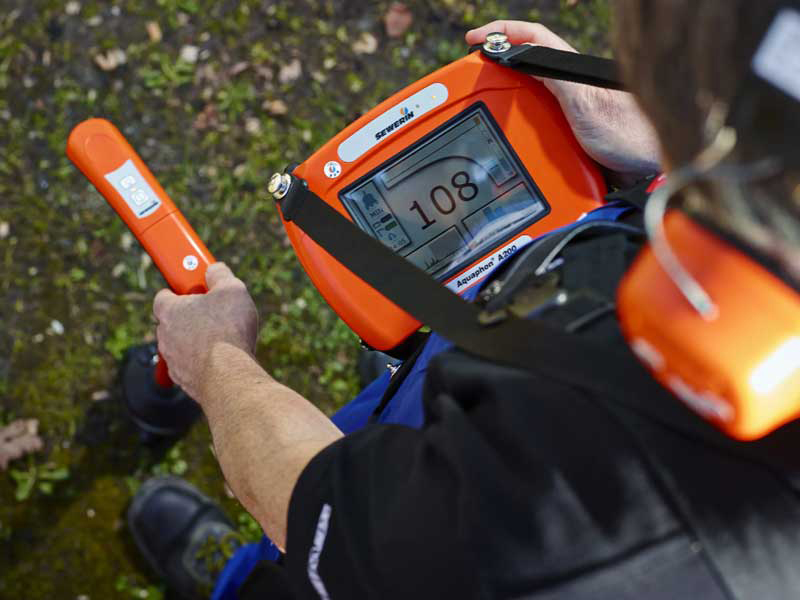
If the leak is outside, you're usually in luck: these are the easier ones. We do a visual inspection first. If nothing's obvious, we introduce tracer gas into the line and use a gas sniffer to find where it's escaping. Outdoors, we rarely need acoustic equipment.
If the leak is inside, the next move is isolating your water heater. We shut off the hot water supply and watch the meter:
- Meter keeps spinning? The leak is on a cold line.
- Meter stops spinning? The leak is on a hot line.
On basement and crawlspace homes, we can often visually confirm the leak once we know which side it's on. Sometimes isolation testing alone pinpoints the problem. When it doesn't, we move to Level 2.
Level 2: pinpointing the exact spot
Hot water slab leaks. A hot line leaking under a slab usually creates a warm spot on the floor, so we bring out thermal imaging to find it. From there, we use acoustic equipment to zero in on the precise location.
Cold water slab leaks. No heat signature to track, so thermal imaging won't help. Instead, we install a manifold (essentially a connection point), introduce gas into the cold water line, and use the sniffer to detect where that gas is escaping through the slab.
Slab leaks can be tricky, and we'll tell you straight: concrete doesn't guarantee a perfect match between where gas surfaces and where the leak actually sits, since gas can travel. We usually narrow it down closely, but not always to the inch. There's also a wrinkle worth knowing about: if the water line runs under the slab inside a protective sleeve, gas can escape from the sleeve itself rather than from the true leak point. When that happens, it often makes more sense to repipe the line than to keep chasing the leak.
Our goal is always to solve the problem once, not patch it today and have you calling us again in six months. In a perfect scenario, we jackhammer, repair the specific section, and we're done. But if the rest of the pipe is old, that same pipe can develop new leaks down the road, and we'd rather have that honest conversation up front.
Once the gas testing narrows the area, we confirm with acoustic equipment before we cut or dig into anything.
The part almost nobody knows: the city may give some of it back
Here's the silver lining hiding in Atlanta's city code. Under Chapter 154, the Department of Watershed Management can grant bill adjustments and credits for things like repaired leaks and billing errors. Requests go through ATL311.com ("Request an Account Adjustment") and must be filed within 12 months of the bill's payment due date.
One detail that matters: the city requires proof. Paid repair invoices, receipts, photos. In the city's own words, invoices without proof of payment will not be accepted.
Which means the paperwork from your leak repair isn't just paperwork. When PV finds and fixes your leak, your invoice and our findings become the evidence for your adjustment request. Fix it first, keep every receipt, then file. (And if you're wondering whether homeowner's insurance can help with the repair itself, that's a separate conversation worth having with your adjuster.)
The bottom line
A sudden spike in your water bill is your home waving a red flag. Here's the order of operations:
- Up around 10%? Probably just life (or July).
- Up 20% or more? Check the meter against the bill first. If they don't match, file with the city.
- They match? Run the 20-minute check: meter-watch test, yard and spigots, foundation, toilets, water heater valve.
- Still a mystery? That's exactly what our leak detection team solves every week, starting with isolation testing and moving to thermal imaging, gas tracing, and acoustics only when we need them.
If you're in Metro Atlanta and your water bill has you scratching your head, PV can help you track it down.
Call us today at (404) 798-9672 or schedule an appointment online!
Frequently asked questions
How much of a water bill increase is normal?
Around 10% is usually just life: guests, extra laundry, or summer watering. A jump of 20% or more (a swing of $30 to $50 for many Atlanta homes) that outdoor use doesn't explain usually means one of two things: water is going somewhere it shouldn't, or the bill itself is wrong.
How do I know if my high water bill is a billing error?
Compare the bill to the meter before you hunt for a leak. Find your meter, read the numbers on the register, and compare them to the "current read" printed on your bill. If the meter shows a lower number than the bill, you have a billing problem, not a leak, and you can file an account adjustment request with the city through ATL311. Atlanta has well-documented cases of meter mix-ups and billing errors.
How do I check for a water leak myself?
Start with the meter-watch test: turn off every fixture and your irrigation system, then watch the meter's low-flow indicator. If it's moving with nothing running, you have a leak. For slow leaks, take a reading, wait two hours without using water, and check again. Then walk the yard for soggy spots and open spigots, check your foundation for moisture, dye-test your toilets, and glance at your water heater's relief valve.
How do I tell if my toilet is leaking?
Drop food coloring into the tank, wait 10 to 15 minutes without flushing, and check the bowl. Color in the bowl means your flapper or gaskets are worn and need replacing. A running toilet can waste about 200 gallons a day, which makes it one of the most common causes of a high water bill. Flush right after the test so the dye doesn't stain.
What is a T&P valve, and can it raise my water bill?
It's the temperature and pressure relief valve on your water heater, and it has a discharge pipe that often runs outside the house. If that valve is dripping or running, you're paying for every drop around the clock with zero signs indoors. A weeping T&P is also a symptom of high water pressure worth having checked. Never cap it: it's a safety device.
How does PV find hidden leaks without tearing up the house?
We start with isolation testing to determine whether the leak is inside or outside, and we check your water pressure while we're at it. If the leak needs pinpointing, we use thermal imaging for hot water lines under slabs, tracer gas and a sniffer for cold lines and yard lines, and acoustic equipment to confirm the exact spot before we cut or dig into anything.
Does the City of Atlanta give refunds for high bills caused by leaks?
The city can grant bill adjustments and credits for repaired leaks and billing errors under Chapter 154 of the city code. Requests go through ATL311.com and must be filed within 12 months of the bill's payment due date, and the city requires proof, such as paid repair invoices. That's why you fix the leak first and keep every receipt.
Do sprinklers and outdoor watering get charged sewer fees in Atlanta?
On City of Atlanta bills, yes. Your sewer charge is calculated from your metered water usage, so every gallon you sprinkle on the lawn gets billed for sewer too, even though it never goes near a drain. County systems like Fulton and Cobb run their own sewer formulas.